
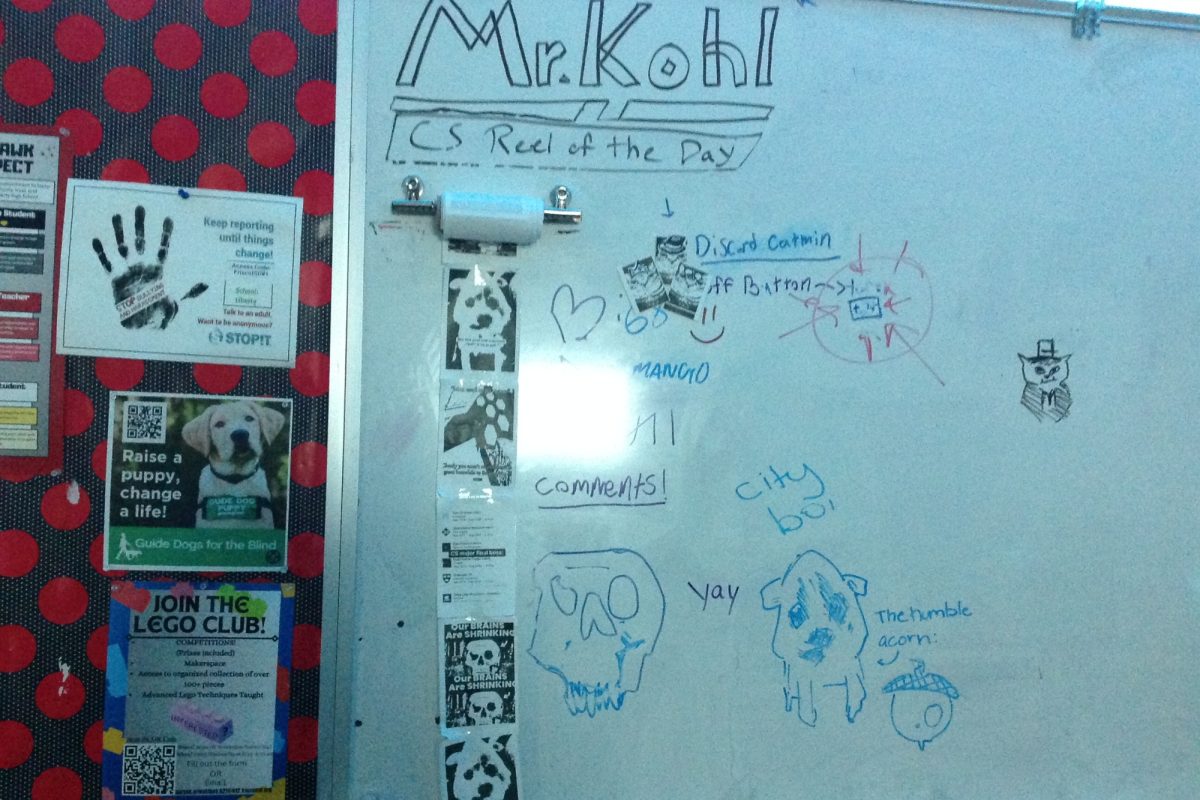
Watching reels in class might be a thing of the past across campus with the passage of HB 1481, but for students in one class, the joy of Instagram lives on, but not on a phone screen.
It all started with a cat.
“So, I kinda printed out a picture of a cat over the summer,” junior Aarav Gowda said. “It was a picture of Vro.”
One picture of a cat that quickly grew into something more.
“Nazim [Ayub] started getting a lot of pictures of Vro and, eventually, he… hanged it up in the [Computer Science A] room and called it the Instagram reel of the day,” Gowda said. “And Nazim went with it and just got more and more pictures of Vro and started, y’know, more and more.”
What originally started as a joke soon for junior Nazim Ayub grew into a way to connect students across campus in the wake of the device ban born out of HB 1481.
“So, to mitigate [the restriction on social media because of HB 1481], we decided to start posting reels in a classroom as a joke,” Ayub said. “However, this became more popular, so for example, more people started liking it, sharing it, even to go so far as adding comments to what they thought about the reel posted in the classroom. And so, ultimately, it’s just a way to connect with other students across different… [class] periods, and ultimately shows how we over-rely on social media in order to communicate and how it’s been such an impact in the physical classroom.”
The process to create these reels consists of a couple steps.
“So, it’s pretty simple actually,” Ayub said. “My friends send reels to me… and then I see oh, is this funny, will this fit the environment? First, you want to make sure that it pertains to the academic environment. So, it’s not offensive at all. And then I ask myself, is this funny? Will people laugh at this? And then, as a result of that, then it gets printed out and posted in the classroom. So, no content is being made, it’s just simply what we all find relatable.”
But those simple printouts – posted every B-day, according to Ayub – soon metamorphosized into something grander.
“It used to just be a still image, but they made a contraption to scroll and stuff,” Gowda said. “So, as far as I know, it’s kinda like a toilet paper contraption where you can actually scroll it now.”
The “reels” are a way to incorporate the fun of consuming digital content into the new device-less academic environment for sophomore Samhith Akkineni.
“The reels’…reminded students that there was still ways to enjoy the content that would otherwise only be accessible on a phone,” Akkineni said. “By printing out the reels and putting them in paper form, it allows students to still have a sense of having their phone, but that still obeys the law.”
And while the popularity of the “reels” seems to have outstripped even Akkineni’s imagination, he still believes that there’s room for more growth.
“I did not think it would gain as much traction as it did now,” Akkineni said. “I thought that it was simple and harmless, but did not realize how many people viewed it. I would like it if maybe the reels expanded to other classrooms in the future instead of just the CS classroom, so even more students can experience the reels.”
But at the end of the day, for Ayub, the goal with the reels is simply about preserving connection.
“So, even though it started as a joke, I think it’s a good way to highlight cultural prevalence in the classrooms, especially with social media,” Ayub said. “We have to understand that it’s such a big part of our lives, whether we like it or not, and just to be able to have that acknowledgement there not only shows that we can connect with each other without our phones, but we can do it in the same way as we do with our phones.”