
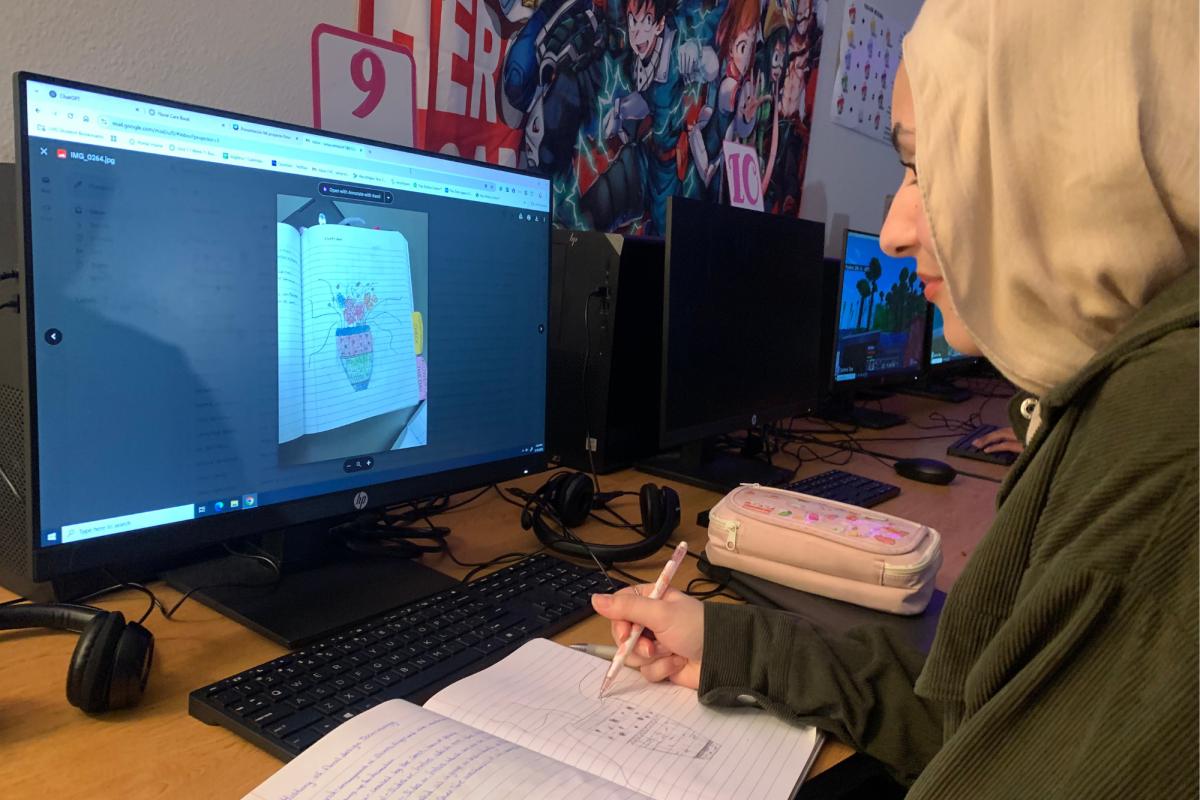
Students in 3D Modeling Animation are getting a bird’s-eye view of a city as part of the biplane project that builds off previous projects that helps students learn step by step.
“This lesson is about motion-path and how students learn to draw a path connected to the plane,” teacher Demas Lamas said. “It can be easier just depending on who you are talking to, but the content is cool when you can connect everything to a path and line.”
This type of animation is about path finding and giving a high level of freedom to how a student wants a plane to fly around.
“This is definitely a cool lesson that we have, students are given a lot of freedom to design and just play around with the paths, and get three different camera angles to film,” Lamas said. “They also can add whatever sound effects they want at the end to make the video more engaging.”
With this project, different camera angles give different perspectives on the plane, and this is the most important aspect of this project so there are different points of view.
“Diffrent camera needs to be practiced,” Lamas said. “How you put one, where do you put it, and learn how to make it follow the plane so it doesn’t fly out of frame.”
Problems are popping up for some students such as the path of the plane, and how to make it not hit a building inside the scene.
“The routing of the plane is the hardest part of this, you have to predict where the path is going to go, it has to have some ups and downs to show variety,” junior Kareem Farag said. “You have to make sure it doesn’t hit anything, but also make sure it has some cool and risky movements.”
After the animation, students have to edit the video from the animation to make more variety, such as adding sound effects.
“Sound effects are a lot of fun, I can have planes flying sounds, and how I can make it crash on the floor at the last second, that is also a sound that I can add,” sophomore Adheesh Rajasekar said. “It is just a high freedom project over all.”