
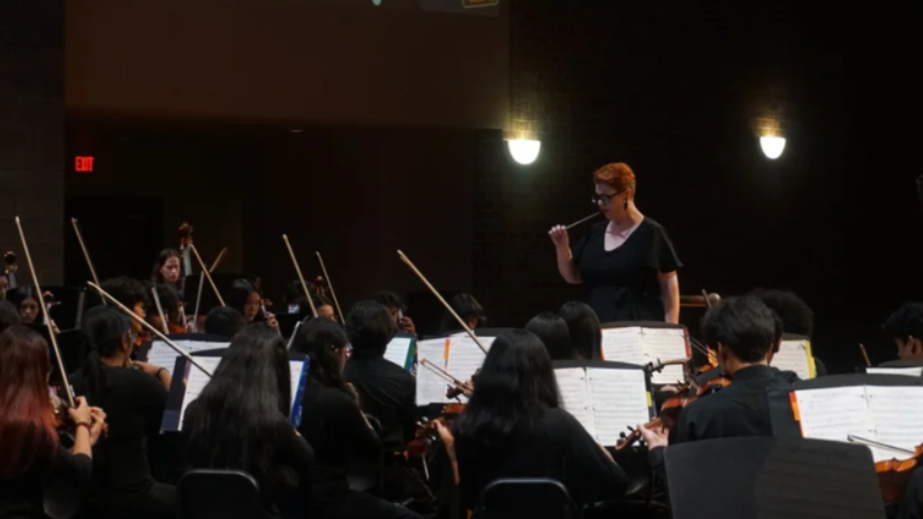
UIL will look a little different for the symphonic orchestra this year as the orchestra aims to make a statement with “R(E)volution”, a tone poem by Armond Vance Wimberly written as a response to the Black Lives Matter movement.
“My friend Mrs. Moore at Lebanon Trail programmed this piece for her non-varsity orchestra in the fall,” orchestra director Julie Blackstock said. “I heard it and fell in love with it. We are required to have two pieces “on the list”. It’s called the Prescribed Music List through UIL. One piece can be a “choice” piece. “R(E)volution” is that choice piece for us.”
For senior Rupal Shirpurkar, the piece speaks to the hopelessness and racism that the composer felt the weight of during COVID.
“He turned to music to cope during this time,” senior Rupal Shirpurkar said. “He mentioned that it was dedicated to a young black man named Elijah McClain; he was killed by the police for simply existing. Vance dedicated this piece to him as he had died at the same age Vance was at the time of the piece. I think this stands out because the music itself feels very powerful and though it is tedious as it’s very long, it’s extremely moving.”
Considering musicality alone, certain elements already make the music memorable. However, symbolism and history is also woven into the music, helping to make it stand out.
“There is an awesome jazzy cello solo at the beginning—so cool,” Blackstock said. “There is a section where the violin 1 section imitates police sirens—it’s very chilling and effective. Then “America the Beautiful” is performed in a somber minor key—showing the dissention in our nation. Finally, there is an African American Spiritual “Go Down Moses” that says “let my people go”. It was initially speaking about the Israelites’ escape from Egyptian slavery, but the African American slaves adopted it as an anthem for themselves as well. It’s very moving.”
Unlike most pieces, the nine minute tone poem is long for a non-varsity UIL piece and will be played at the spring concert as well, in order for its message to reach a larger audience.
“After sightreading this piece for the first time, our orchestra was very excited to play it for UIL,” junior vice president Allison Truong said. “We decided to also play it for our spring concert because we believed that its message and themes needed to be played in front of an audience, rather than just a panel of judges. ”
To prepare, students have met in sectionals and peer reviewed each others’ five to eight minute practice videos on top of regular class rehearsals. However, the work that the piece requires is worth it for many orchestra members.
“Something I like about it is of course how well the piece comes together,” Shirpurkar said. “This piece is truly amazing and I can’t wait for it to be put together all the way.”
Police siren imitations are a highlight for multiple musicians, even for those who will hear them from across the stage like freshman bassist Izzy Njoku.
“The sirens played by the violins in the piece are something very memorable, in my opinion,” Njoku said. “I think they have a symbolic meaning, especially in this piece, as it adds to the building of tension, overall.”
Students were able to read Armond Vance’s program notes attached to the score, allowing for a deeper understanding of the piece and its composer’s intentions.
“R(E)volution’s rich use of various themes and elements, each note carrying significance is what I love about this piece so much,” sophomore Sophia Essa said. “I would definitely recommend for people to read the program notes behind the composition, as it thoroughly delves into the piece’s meaning in ways that I can only hope to encapsulate in this.”
Sending an impactful message is what makes the piece meaningful to senior Shreya Philip.
“I like that this song holds a story and we are sending a message with it as I have never done a piece like this before,” Philip said. “I also really enjoy the bright and bold violin melody that shines with the whole ensemble! The most challenging part is definitely the length of the piece and also making sure to be on count as we have about 24 measures of rest.”
The composition acts as powerful social commentary on the historic silencing and discrimination of marginalized groups according to Essa.
“This piece carries a message that has often been underrepresented throughout music in the modern era, partly due to the prominence of European/ Western music and arts,” Essa said. “Getting to play a piece that, although long, speaks a message about a significant movement in American history—about a group that has been repeatedly marginalized—and incorporates the voices of so many that have been silenced for centuries, is one of the things I and many others love so much about music. It’s the ability not just to express yourself, but to transform, to incite feeling and call to action in others.”