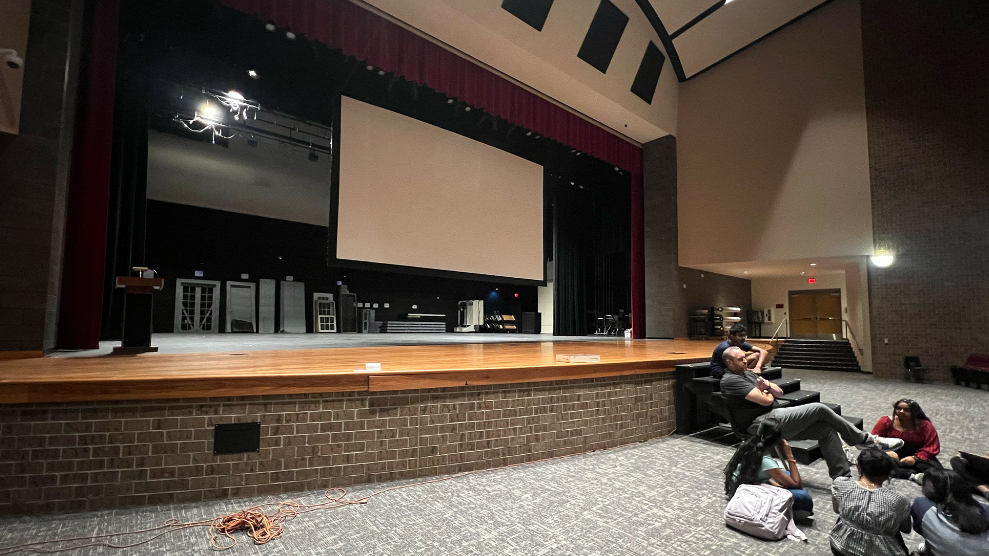

Preparations have begun in theater 2, 3, and 4 for The King Stag, where students are diving into commedia dell’arte, an older form of theater with stock characters that allowed troupes to create and perform multiple storylines with the same characters.
“The play is a story about a king in an imaginary land,” theater director Kristopher Allen said. “His dead father has required him to get married before his 25th birthday and he’s choosing from all the women in the land. The problem is that he’s pretty gullible and people lie to him a lot. His closest advisors lie to him—and he knows that. So he hires a magician to put a spell that allows him to know the truth. So it’s all the antics and craziness of all the women and the men who are trying to take the kingdom from him.”
Senior Lexi Holding is the student director, but the show is one that some students are already familiar with, giving them an advantage design-wise.
“King Stag is actually the UIL Theatrical Design show this year so all of the schools in the state compete in designing for that show,” Allen said. “So I thought if we’re already doing all that work, we might as well just put it up [for the spring show].”
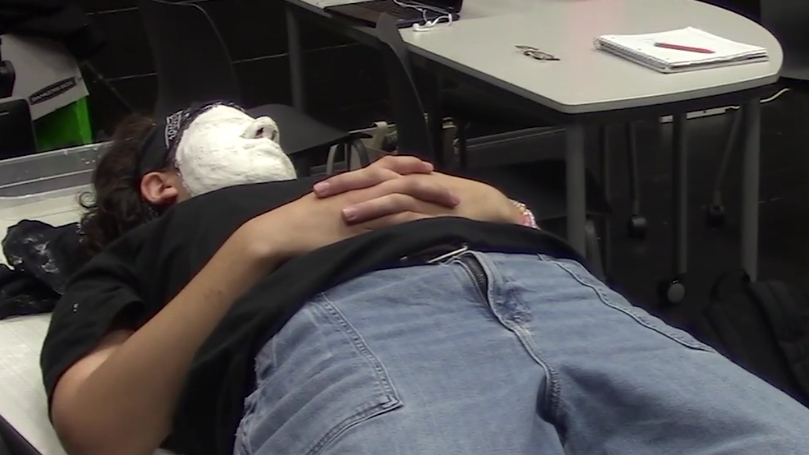
As a part of commedia, theater students have created masks specifically tailored to them and their characters.
“Commedia dell’arte translates to something like ‘comedy of the artisans,’ and the discipline itself comes from the Mannerist era of Italian art,” sophomore Viraj Mallampalli said. “In performance, it emphasizes improvisation and exaggerated physicality, and its themes typically involve social commentary and satire. Masks are very commonly used to make characters easily recognizable and their personalities visually apparent.”
Commedia encourages drama, adding a layer of complexity as students learn to become their character.
“The most challenging part is the way we have to move,” junior Marlowe Crater said. “Commedia also requires overly dramatic movements with your archetype, which is hard to continuously do because you can’t go too fast, not too slow, and it’s challenging to maintain that along with your lines. Usually, you don’t think about the movements you do with your lines because you just do what feels right for the tone but with commedia, it’s dramatic to the max.”
The show’s physical comedy may be the most challenging part for some students, but for senior Anagha Konuru, it’s also among the most rewarding parts of it.
“My favorite part is developing my character’s walk and mannerisms, and well as being the complete goofball of the show,” Konuru said. “The most challenging part for me is, funnily enough, also the physicality, because the extreme comedy of Truffaldino is very physically demanding. Most of my roles are pretty physically demanding but I’m bordering on acrobatics. However, I think I’ll be able to push through and deliver a performance I’m proud of.”
However, for Mallampalli, who plays Tartaglia, one of the King’s advisors, giving the characters life and making them and their histories feel authentic is a challenge.
“The most challenging part of The King Stag so far has mostly been doing justice to the relationships between each character, which ostensibly involves years of their histories,” Mallampalli said. “It’s something that is tedious to flesh out, but also very important to build, as it directly affects the immersiveness of the show.”